A New Year’s resolution: to be there.

No one, not your spouse or partner, your best friend, your colleagues, your relatives or your neighbours, will value time spent with you quite like your own children do. To them, just five minutes of your undivided attention, are worth a whole day of half-listening.

Like a lot of busy parents holding down full-time jobs, my wife and I juggle work with family and we never reach the right balance. We are fortunate to have full-time jobs and very fortunate to have four children, so I am not complaining, but we should make time because they are getting older quickly – now eighteen, sixteen, thirteen and eleven. Within the blink of an eye they have grown from little ones to young adults and within another blink they will soon be off to university, work and independent living. They will have homes of their own and I’ll still be shouting ‘dinner’s ready’ up the stairs.

I look through the family albums and I see so much we have done together. But I am constantly puzzled by how few events I can actually remember. I am there in the scene, arms around my children, smiling at the camera, sitting in our tent eating spam in the middle of a Yorkshire field, perching on a quay side eating Devonshire ice cream, or huddling on a windswept beach in Suffolk. I know was there, I have proof; our house is adorned with ornaments and pictures brought back from family trips.

It is not that I have a particularly poor memory; the problem is this: I was always there in body but seldom there in mind. I was often thinking about other things – usually a book I was working on at the time, a course I was about to run, or the familiar stresses and strains of a career spent in teaching and school leadership. But at least I was there.

Being there in body is not enough. I need to be there in mind too. I have to attend – listen, pay attention, respond meaningfully, remembering at all times that I am making memories. I have always said that a family holiday is not really for us adults; it is for making memories that the children will remember when they are older. I still believe this is true and I am pleased that the children have childhood experiences they can remember. But I should have been making indelible memories for myself too. For when we grown-ups retire from work and start reflecting back on our lives, how many of us will conclude that we should have spent more time at work and less time at home? And of the time we did spend at home, how many of us will wish we hadn’t concentrated so much on what our children were saying? Think about it, what else could possibly have been more important? How many of us would rather their memories of work were more vivid than their recollections from home? Colleagues will forget us as soon as we’ve left, but our families never will.

Perhaps it’s due to that inconvenient truth that many of us are more polite at work than we are at home. Family life does not require us to act with professionalism, no matter how much more we love our families than we do our colleagues – no offence intended, I have super colleagues! I can sustain interest at work far more readily than I can at home. When a line manager or colleague gives me instructions, I can listen intently, or certainly give that impression; but when my wife gives me instructions, she knows full well it is going in one ear and out the other. Sometimes I don’t even pretend I’m listening.

Twenty years we’ve been married – twenty years of conversations and I can’t remember any of them.

But I can attend and concentrate at work when I have to. I can chair a meeting at work and recall with reasonable clarity what was said in it. I can give a child at school my undivided attention and remember a comment they made to me months later – it is my job. But ask me what my own children said to me at lunch yesterday and I struggle to remember the detail. Why is that?

Showing and telling to an appreciative audience is an important part of a child’s growth and development, not to mention their self-worth. I know this because I say it at school all the time. Children need and deserve a captive crowd to whom they can show and tell their achievements. But as a parent I worry if I’m a cardboard cut-out audience. I smile and make positive noises at the right moments, whilst thinking about something else.

When I am ready to stop working and stop stressing about other things, when I am ready to be a fully interactive and appreciative audience for my children, they will be children no longer and that worries me. Perhaps that is the way it is and always has been for us parents. It is why grandparents are so cherished by their grandchildren.

It is possible I have done myself a gross injustice here – my wife thinks so. There have been plenty of times when I have not been thinking about work and instead have been thinking intently about my children. And that’s just the point. While they talk to me, I look at them, cuddle them, worry about them, wonder if they are healthy and happy, wonder how they’re getting on at school, wonder if they need a haircut, worry if they’re not eating enough, or eating too much, worry if anything is worrying them – and all this while they are still talking to me. Perhaps there is always a sub-text or a distraction within every conversation you have with your own children, precisely because of these parenting worries that you cannot switch off when you focus on their faces. But all they really want is for you to listen!

As another year begins, I will resolve to make space in my busy diary to stop, look and listen. I will make special effort to be there and remember.

Published in Bury Free Press, Friday 4th January 2019



Concentration of a different kind

We often hear today that children’s attention spans are shortening. ‘They just can’t sit and concentrate for half an hour, like they used to!’

I question this. Most children can still concentrate for thirty minutes, but they chop it up into five chunks of six minutes and run them concurrently. I’ll give you an example: one of my four children operates his X Box controller like a Jedi-master. I’ve seldom seen a human so deft, his eyes darting across the screen like guided lasers, while his fingers and opposing thumbs twiddle and twist with pin-point accuracy. But this is not the extent of his skill; at the same time as playing his game, he can communicate with a distant co-player through his headphones, search for cheat codes on his mobile phone, balance his shoe on the end of his toes, swing to and fro on his chair and argue with his sister.

Does he have a problem concentrating? I don’t think so.

As a middle-aged father I encourage my son to adapt to my world, whilst secretly trying to acclimatise to his. We meet somewhere in the middle.

Silence rarely exists in my son’s world; there is always white noise. It is a multimodal landscape through which he navigates with the precision of a SatNav. Conversations with him are rapid, words are used with breathless efficiency. He seeks and finds meaning quicker than I can process a question.

Does he have a problem processing information? I don’t think so.

Multiply my son by thirty and you have a typical class. If each student has the same capacity to juggle quick-fire tasks, that is one hundred and eighty different things all happening at the same time in the same room. Not only can many children juggle tasks in this way, they crave the the busy buzz such juggling brings. That is not to say they should all be given so many concurrent tasks, it would be impossible to manage! But neither should we require them all to focus on just one.

Is it time to re-think the way we teach? Is it time to consider what learning looks like? Is there a difference between learning and just doing? Are educators like me teachers, coaches, facilitators or orchestral conductors?

I could try to encourage my son to focus on one thing for an extended period of time, try to strip him of his penchant for multitasking, not least for the purposes of passing an exam, but I wonder whether this will help or hinder him in the world he is going to inhabit – a world in which communication, interaction, occupation and leisure co-exist like never before.

But nothing beats a good story. He can gaze, transfixed, for hours at a cinema screen if the film is engaging enough; he doesn’t move. Perhaps this is because the film is simulating that familiar landscape in which he thrives – short bursts of action, dialogue, music and sound effects, with rapidly-changing camera angles and plot twists. Is this a clue to how teachers, the lead storytellers in the room, should hold their pupils’ attention?

How do we re-create this experience in the classroom? Should we even try? Should school be the last bastion of monologues and soliloquies from the front? Should my school be a sanctuary from the rapid race outside its walls?

Has the function of a school descended into being the place where my son learns to sit still, listen quietly and raise his hand at the appropriate moments? I don’t believe so. School is for growing minds and developing character and perhaps the optimum growing conditions in which this happens have changed.

When I was at school there was no internet, no mobile phones, no satellite television, no video games and no digital radio. The learning tools in school mirrored the leisure tools at home: books, cassette tapes, video recorders, comics and magazines, face-to-face conversation.

But the world of home has changed. Have schools caught up yet? Perhaps they should race ahead and provide a vision of what is to come?

Or is the true function of a school to be a conduit between the past and the future, anchoring children, just like my son, somewhere in the middle.


22nd Century children are here, now.

Across the country, many children will have started school for the very first time last week. Their parents and carers may have watched them toddle off, unfazed, into the Early Years playground, or fought to unpick their tiny clutches and re-attach them, like some reluctant koala, to the friendly but unfamiliar adult greeting them at the classroom door.

As we reflect on such milestones in childhood, it is worth pausing to gaze at the long road ahead. The majority of children starting school today will live to see the twenty-second century and more than a quarter of them will become centenarians. Artificial intelligence is likely to transform their future employment and may even assign the idea of ‘having a job’ to the history books. Domestic robots may run their household, manage their finances and even remember to put the bins out the night before collection; socialising will continue to be conducted mostly online, as it is already; the most favoured forms of entertainment will likely take place in virtual or augmented realities; and factual knowledge – that highly-prized and measurable commodity peddled in school since the days of Gradgrind – will be instantly available at the press of a button or the mere thinking of a question, when the answer will be dropped telepathically into the questioner’s brain by their life-long, simulated pet pooch, a descendant of Siri.

If the adult lives of the children in our schools today will be dominated by leisure time, as many predict they might be, how then are we preparing them for this new world? How are we helping them to protect themselves from information overload and anxiety or a lack of purpose and direction? How are we equipping our children with the self-discipline and creativity they will need in order to find meaning and purpose in an adult life of leisure, when robots take up the mantle of work and leave them with time on their hands?

Defining your worth by your work is a burden still carried by people of mine and my parents’ generations, and a century of antecedents before us. When I was at school in the 1970s and 80s we believed the myth that good things only came to those who studied hard in school, achieved good grades and then worked hard nine to five. The question, ‘What will I be when I’m older?’ hung over our heads and put a stop to playfulness from the age of about fifteen onwards. But ask an employee of a high-tech company today and I suspect the lines between work and play are blurred for them. Ask a creative entrepreneur and they will probably tell you that it is not how hard you work that brings wealth and opportunity, it is how you connect people together and then motivate them, how you imagine different futures, how bravely you embrace change and whether you can create solutions before others have even perceived a problem. AI can optimise but it can’t create, only we can do that.

If a revolution in education is coming, let it not only be based on what AI can do for us; let it be driven by what we can do that AI can’t. May it force us to re-discover the facets and capacities that make us human. May we redesign our schooling system so that it values creative thinking and innovation as much as literacy and numeracy.

For it may not be the children’s arithmetic, verbal reasoning or knowledge retention skills that enable them to prosper in an AI-dominated world – computers will always outperform us in all of these disciplines; rather, it will be their tacit knowledge that shapes the life stories they write for themselves: knowledge that is not so easily verbalised or measured, but gathered via our senses, learned through observation and imitation, and influenced by our cultural inheritance and life experiences. These are the things that really matter because they make us who we are and who we could become.

As a new school year begins, what a tremendous challenge for school leaders like me: to find ways of nurturing the ‘deep-down-things’ that make us human and that will ultimately bring success and fulfilment to the children who started school this week, long after we have all retired.

First appeared in my monthly column in the Bury Free Press, Friday 7th September 2018


Three truths about school

This is going to be controversial: school is about hard work, discipline and respect.

In the twenty years I’ve been teaching I’ve seen a transformation outside the school gates. Innovations in technology and global communications have transformed the way we work, shop, socialise and spend our leisure time. Such changes, inconceivable when I was a student, getting to grips with my ZX81, have prompted educators like me to cry for more creativity, innovation and independent thinking in schools. We must find and nurture the tech entrepreneurs of the future. We must tailor our teaching to meet every individual’s needs; we must safeguard children’s natural curiosity and develop a joy of learning, promoting a playful attitude to work; we must place happiness and well-being at the centre of our schools. We must celebrate and protect the wonder of childhood, because it is this that will spawn creative thinkers of the future.

There is nothing here that I disagree with, and most of it I’ve been calling for throughout my career.

But buried beneath the revolution in the way we live and work has been a transformation of a different kind and it’s one we don’t like to talk about much: the slow erosion of fundamental values which shaped the ethos of the schools and communities in which my generation grew up. There were malign elements, of course, that we’re all glad to see the back of – corporal punishment, for one, or prejudice of varying, cruel kinds. But what of discipline? What about hard work? Mutual respect? It is a brave headteacher who incorporates these seemingly old-fashioned values into their mission statement, the more common trend being for words like aspiration, creativity, independent thinking or self-confidence.

I continue shouting for a playful, enjoyable approach to learning, but I’m reaching the conclusion that such a mantra assumes that everything is functioning well outside school – that discipline, respect, and diligence are all instilled at home and in the wider community, thus leaving us creative teachers free to promote a spirit of enquiry and a joy of learning in our schools.

So I dare to say again, school is about hard work, get used to it. Your independence is important, but it’s not as important as the inter-dependence that comes from mutual respect. Creative endeavour is important too, but without self-discipline it is nothing. Far from shirking responsibility or self-discipline, the great thinkers, inventors and creative artists of the past only succeeded because of their hard work and self-discipline.

If increasing numbers of children lack role models in their lives outside of school, from whom they can learn a good work ethic, a sense of social responsibility and self-regulation, then surely it falls to schools to champion these values once again.

There are reasons, often tragic, why children lack such role models at home; I am not apportioning blame. As a parent of four children, I know that parenting is difficult, there is no handbook, and the scandalous cuts in funding for social care and family support – which I saw for myself as headteacher of a primary school in a poor community with large numbers of disadvantaged and vulnerable children – have meant that many children lack direction, a moral compass and often even the most basic care.

Yes, all children have a right to an inspirational education filled with creative opportunity, aspiration and teaching tailored for them, but so too do they deserve to be told – by someone – that hard work, self-discipline and mutual respect are important. If this message is not being delivered to them at home, or through the media or modern popular culture, then it’s school that can say it, no matter how unfashionable it sounds.

Discipline, hard work and mutual respect are words that seem outdated and some may even think they threaten creativity, well-being or character enrichment. I think they underpin them.

When such qualities are instilled in students, modelled by their teachers, schools can truly take off.


Four steps to Creativity

The Proustian phenomenon tells us that our sense of smell has more power than any other sense to provoke distinct and emotional memories within us. In his novel, À la recherche du temps perdu (In search of lost time) Marcel Proust describes a character vividly recalling memories from his childhood after smelling a tea-soaked biscuit. Memories, long-forgotten, can often come flooding back to us, when certain smells are encountered again.

A whiff of bacon and egg does it for me. I am always whisked away to Weston-super-Mare, aged seven, going for a morning stroll with my Grandpa. At the end of his road, just near the sea front, was a nursing home for the elderly and every morning the most luscious smells of full English breakfasts would blast out of a vent in the kitchen wall. The seaside, for me, doesn’t smell of seaweed, it smells of bacon.

Trips to Weston were always a sensory adventure. After serving in the war as a bomb disposal expert, my grandpa turned his steady hands to chiropody and his surgery was inside the house. The unforgettable smell of phenol and salicylic acid would always greet us in the hallway after my Nana had opened the door with a beaming smile.

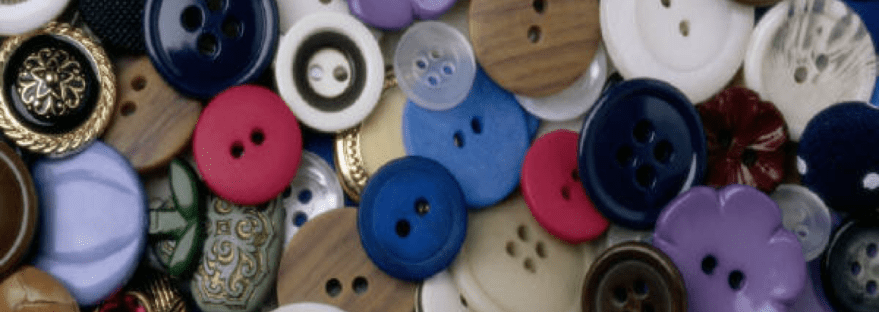
But the most memorable part of our weekends in Weston wasn’t the chemicals or the bacon or the seaside. It was my Nana’s old wooden button box – a large, rectangular open tray with a handle across the top of it. It was divided into several felt-lined compartments and each one housed the most extraordinary delights you could imagine. Shiny blue ones, pearly white ones, two holes, four holes, leather toggles, great big brass ones, tiny red spherical ones. Some so small you could imagine an elf sewing them onto a shirt, others so large they must have fallen from a giant’s duffle coat. And then there were the military ones, my favourites, with emblems and crests and royal coats of arms. You could only imagine the places they’d seen, peering like eyes from the tunic of a sailor.

How I loved that button box. I’d spend hours rifling through it, listening to the clickerty-clack of the little buttons rattling in the tray, running my fingers through them like sand on the beach beyond the nursing home. Watching the colours as I blended them all together into a multi-coloured, chunky soup. Laying them out in rows and creating patterns across the floor. Threading them onto string and making my Nana a necklace or my father a pretend wristwatch. Button men, button roads, button food and button jewellery. How could anyone resist their enticing appeal?

If you want a definition for what creativity is, then you need look no further than your grandmother’s button box. I have thought a great deal about why I was so transfixed by it – why hours would pass unnoticed while I was so absorbed. They call it being in ‘flow-state’ these days. I’ve often mentioned that button box when delivering CPD training in schools and it’s astonishing the number of teachers who smile and nod their head. It seems I wasn’t the only one who liked playing with buttons. There is a common fascination in childhood for sorting, shaping and creating.

I know now what I was doing during those trips to Weston. I was engaging in pure, unfettered creativity and I believe there were four distinct stages to it.

Firstly, I was using perception. I rifled, sifted, flicked and clicked. I swirled them around and studied all the colour combinations and varieties. I studied them with great care and interest. Their differences intrigued me – so many variables in one wooden box. I used my senses to get to know them all, see and feel them, hear them clickerty-clack in my hand, become familiar with all the constituent parts of the creations that were to follow.

Secondly, I made connections. I loved nothing better than dropping them over the carpet and sorting them into different categories, coloured or plain, two holes or four, round ones, toggles, odd shaped ones, plastic or metal. There was something very pleasing and therapeutic about the practice of sorting them into groups. I remember, years later, I found myself working in a petrol station as a student. I used to tip the packets of cigarettes all over the kiosk floor just so that I could sort them out again (it broke the monotony of a night-shift). Their different coloured designs pleased me and they stacked up so well together – making an ideal Jenga substitute during quiet shifts.

Back in Weston, there then followed a really exciting stage in my work with those buttons, the synthesis stage. I blended and connected and combined those buttons to create original designs and products, from sculptures and collages to roads, figures and jewellery. These were different every time and I was proud of them. They meant something to me and those buttons allowed me to give vent to my imagination in a physical way. The button box was a palette and I was the artist, synthesising the elements together with imagination and vision. It didn’t occur to me that there was a wrong way or a right way to build a button man, or a button chain – so I wasn’t afraid to ‘have a go’ and just see what I could make. It was the same with Lego – a construction toy with which I am still besotted even now. Back then, of course, I would grab any pieces I could find from the giant tub of crusty blocks and knock up a vehicle, spaceship or hobbit’s hovel from my imagination. Now, as an adult, I mindlessly follow Lego kit instructions and call it therapeutic.

After the synthesis stage came the final part, the presentation. This was the much anticipated ‘tadaah’ moment, when I ran into the kitchen, grabbed my Nanna, pulled her by the hand into the front room and said ‘Tadaah! What do you think, Nanna?’ A rapturous response always ensued. Nanna’s arthritic hands were misshapen and twisted but I knew she had once loved playing with those buttons as much as I did and my elaborate designs never failed to bring a smile to her face.

The four stages of my button work were of equal importance, though I didn’t realise it at the time. All I knew was there was a procedure to it, a kind of ritual that I always followed, enjoying each stage, and especially the last.

Perceiving, connecting, synthesising, presenting – you need all four stages for creativity to flourish in schools. My book, Teaching for Creativity, is about how to plan for each one in your classroom.

Teaching for Creativity is the second title in the Invisible Curriculum Series, published by John Catt Educational. Click here to view it.